 Sep 06, 2026 - 0
Minutes read
Sep 06, 2026 - 0
Minutes read
Home Service Agency Studio Review: Features, Pricing, Pros & Cons
What Is Home Service Agency Studio?
Home Service Agency Studio Features
Building websites for local businesses can sound like a simple service until you are handling layouts, niche-specific content, images, client details, forms, revisions, and prospecting at the same time. That workload can quickly become repetitive, especially if you are creating similar sites for plumbers, roofers, HVAC companies, landscapers, and other home-service businesses. That is why a system designed specifically around this market deserves a closer look.
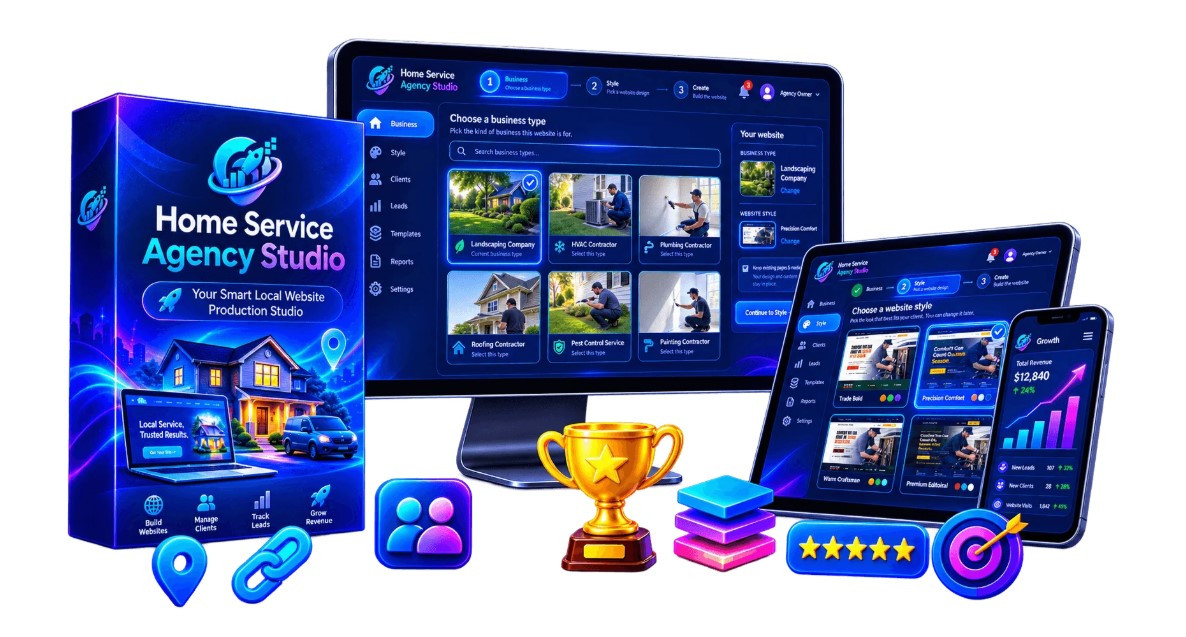
Home Service Agency Studio aims to make that process more structured by combining WordPress website designs, ready-made niche content, customization tools, prospect demos, and commercial client-delivery rights. This Home Service Agency Studio Review breaks down what the platform does, how it works, its main features, current pricing structure, advantages, limitations, and whether it makes sense for freelancers or agencies that want a more convenient way to build local-business websites.
What Is Home Service Agency Studio?
Home Service Agency Studio is a WordPress-based website creation and client-delivery system designed primarily for freelancers, digital marketers, web designers, consultants, and agencies serving local home-service businesses.
Instead of starting every website with an empty WordPress installation, the platform gives users pre-designed website styles and niche-specific content that can be personalized for individual businesses.
The core package currently includes five website styles and ten home-service niche packs, giving users as many as 50 basic style-and-niche combinations before further customization. Published product information lists the supported niches as HVAC, plumbing, roofing, landscaping, pest control, painting, garage-door services, tree services, pressure washing, and handyman businesses.
The five listed design styles are:
- Trade Bold
- Precision Comfort
- Warm Craftsman
- Premium Editorial
- Friendly Modern
Because the system runs through WordPress, you are not locked into only displaying a static demo. The goal is to take a website from initial setup through customization, prospect presentation, and eventual client delivery.
One particularly important point is that this is not a tool that automatically creates a profitable agency for you. It primarily simplifies the website-production side of the business. You are still responsible for prospecting, communicating with customers, closing projects, customizing sites, and managing client expectations.
How Does Home Service Agency Studio Work?
Home Service Agency Studio uses a fairly straightforward workflow.
1. Install the Studio
You begin with a WordPress installation and add the Home Service Agency Studio system.
Instead of manually assembling every part of a client website, the Studio becomes your starting environment.
2. Select a Website Style
Next, choose one of the available design styles.
This helps you match the website's visual direction to the type of company you are targeting. For example, a roofing contractor may need a different visual feel from a landscaping business.
3. Choose a Home-Service Niche
You then select the appropriate niche content pack.
Rather than writing every service page and basic piece of website copy from zero, you start with content prepared for that particular industry.
4. Personalize the Business Information
The next step is replacing the general information with details specific to your prospect or client.
That may include:
- Business name
- Logo
- Phone number
- Email address
- Services
- Service locations
- Branding
- Calls to action
- Contact information
- Quote settings
The pre-built material should still be reviewed and personalized. Using identical copy and imagery across several clients would reduce the uniqueness and quality of the finished websites.
5. Create a Prospect Demo
This is where the platform becomes more than a standard WordPress template collection.
Home Service Agency Studio includes tools intended to help users create personalized website demonstrations for businesses they want to approach. Some published descriptions also reference Google Business Profile-based demo generation and bulk prospect workflows.
Instead of contacting a plumber and simply saying, "I can build you a website," you could potentially show that business a website concept prepared around its services and branding.
That makes the offer much easier for a prospect to visualize.
6. Customize and Deliver the Website
If the business wants to move forward, you can finish customizing the website and deliver the completed project.
Commercial client-delivery rights are reported as part of the front-end package, meaning users can create and sell completed client websites. Those rights do not mean you can resell or redistribute the underlying Home Service Agency Studio software itself.
Home Service Agency Studio Features
The value of the system comes from combining several tasks that freelancers normally handle separately.
Five Professional Website Styles
The five included styles give you different starting points without requiring you to design every project from scratch.
That can be particularly useful when prospecting several companies in the same industry. A roofing business and another roofing business do not necessarily need to receive websites that look identical.
However, five styles are still a relatively small library compared with large general-purpose WordPress template platforms. Agencies that need highly customized designs may still spend substantial time modifying the original layouts.
Ten Home-Service Niche Packs
The ten included niche packs are one of the strongest parts of the offer.
They cover:
- HVAC
- Plumbing
- Roofing
- Landscaping
- Pest control
- Painting
- Garage-door services
- Tree services
- Pressure washing
- Handyman services
These are established local-service categories where businesses commonly need websites for service information, quotes, calls, and local lead generation.
For an agency working specifically with these industries, niche-ready content can eliminate a significant amount of repetitive setup work.
Centralized Website Personalization
Instead of manually editing the same business information across multiple areas, the system is designed to simplify personalization.
This can help when adjusting client names, contact details, branding, services, and calls to action.
The feature does not remove the need for quality control. You should still check every page before presenting or delivering it to a client.
Personalized Prospect Demos
The demo system is arguably one of the more interesting features from a sales perspective.
A generic cold email gives a business owner very little to evaluate. A customized website demonstration gives the prospect something concrete.
It does not guarantee that the prospect will become a customer, but it can make the website offer easier to understand.
Instant Quote Functionality
Published descriptions of the front-end package also list a configurable Instant Quote workflow.
For home-service websites, quote requests can be useful because many contractors rely heavily on inquiries rather than traditional online checkout.
Search-Focused Foundation
Product descriptions reference support for traditional SEO as well as newer terminology such as AEO, GEO, and LLM.txt foundations.
That may provide a useful technical starting point, but buyers should avoid assuming that installing the Studio will automatically produce strong Google rankings or AI-search visibility.
Search performance still depends on factors such as content quality, competition, backlinks, technical health, local optimization, reviews, authority, and ongoing SEO work.
Commercial Client Rights
The commercial-use component is essential for anyone purchasing the product as an agency tool.
The front-end license is reported to allow buyers to create, customize, sell, and deliver websites to paying clients.
That makes the platform substantially more useful than a template package intended only for personal sites.
Home Service Agency Studio Pricing & Plans
At the time of writing, the Home Service Agency Studio front-end launch price is listed at $27 as a one-time payment. MunchEye also lists Dawn Vu's Home Service Agency Studio launch at $27 on WarriorPlus.
Because this is promotional launch pricing, the amount can change. Always verify the current checkout price before purchasing.
The reported launch funnel looks roughly like this:
| Offer | Reported Price | Main Purpose |
|---|---|---|
| Home Service Agency Studio | $27 | Core Studio |
| Optional prospecting bump | $16.95 | Prospecting/message tools |
| Premium Upgrade | $47 | More styles and niche packs |
| Pro Home Service Business Addon | $67 | Additional AI/business tools |
| Niche Expansion Pass | $97 | Ongoing styles and niche expansion |
| DFY Hosting & Management | $297–$497/year | Hosting and site management |
| Local Alchemist AI Bundle | $247 | Expanded local-marketing tools |
| Local Template Store Bundle | $127 | Local marketing template business |
The optional upgrades can increase the total cost considerably, so you should evaluate them individually instead of assuming every upsell is required. Published breakdowns indicate that the core front-end package is intended to work on its own, while the additional offers expand the system.
For a beginner, starting with the core product and learning the workflow before purchasing several upgrades would usually be the more cautious approach.
Pros and Cons of Home Service Agency Studio
Pros
Niche-specific approach
Instead of trying to serve every possible business category, the platform focuses on home-service companies.
That makes its templates and content more relevant to users targeting local contractors.
Faster starting point
Pre-built styles and niche content can reduce the amount of time required to get a project from an empty WordPress installation to a usable initial draft.
Useful prospecting concept
Being able to present a personalized website concept may make an agency pitch more tangible than simply sending a cold email or portfolio.
Commercial client delivery
The ability to sell the finished websites is important for freelancers and agency owners who want to monetize the system directly.
Relatively inexpensive front-end
At the reported $27 launch price, the initial financial commitment is comparatively low for someone who specifically wants to test a local website-service model.
Cons
It does not find clients automatically
You still need a real client-acquisition strategy.
Cold outreach, referrals, networking, paid advertising, local SEO, or another prospecting method remains your responsibility.
WordPress knowledge is still useful
The system is designed to simplify website production, but basic knowledge of WordPress, hosting, domains, plugins, backups, and website management can still be valuable.
Pre-built content needs customization
Ready-made material saves time, but publishing it without personalization could result in generic or repetitive websites.
The upgrade funnel can become expensive
The $27 front-end is only the entry point. Buying multiple optional upgrades can push the overall investment substantially higher.
Limited to particular niches
If your agency mainly serves restaurants, lawyers, doctors, SaaS businesses, e-commerce stores, or completely different industries, the included home-service packs will have less value.
Who Is Home Service Agency Studio Best For?
Home Service Agency Studio appears most suitable for people who already have—or genuinely plan to build—a local-business website service.
It may be a strong fit for:
- Freelance WordPress designers
- Local SEO professionals
- Digital marketing agencies
- Local-business consultants
- Website freelancers
- Lead-generation marketers
- Beginners building a local website agency
- Agencies targeting plumbers, HVAC companies, roofers, landscapers, and similar trades
Published product information specifically positions the system toward local marketers, freelancers, consultants, web agencies, and service providers targeting the home-service market.
However, it is probably not the right product for someone looking for effortless passive income.
Buying website-building software does not create customers by itself. You need to be willing to prospect, communicate with businesses, handle revisions, close deals, and deliver a professional result.
It is also less attractive if you prefer building completely custom websites with frameworks, custom code, or advanced application functionality.
Is Home Service Agency Studio Worth It?
Home Service Agency Studio can be worth considering if your goal is specifically to build and sell websites to home-service businesses.
Its biggest advantage is not any single template or automation feature. The stronger value proposition is the repeatable workflow: choose a niche, choose a design, customize it, prepare a demo, present it to a prospect, and then finish the website if the prospect becomes a client.
At the current reported $27 launch price, that can be an accessible way to test the model without making a large initial software investment.
But buying it simply because the price is low would not be enough reason.
Before purchasing, ask yourself:
- Do I actually want to sell websites?
- Am I willing to contact local businesses?
- Do I understand basic WordPress management?
- Are the ten included niches relevant to my target market?
- Will the pre-built system genuinely save me production time?
If most of those answers are yes, the core product looks considerably more useful.
If you are mainly hoping the software will automatically generate clients and income, your expectations are likely to be disappointed.
Conclusion
The hardest part of running a small website agency is often not building one attractive site—it is repeating the process efficiently for the second, tenth, or twentieth client. Home Service Agency Studio addresses that specific problem by giving local marketers a structured WordPress workflow rather than another blank starting point.
Its five styles, ten home-service niche packs, prospect-demo tools, customization workflow, and commercial rights make the core package interesting for freelancers who want to specialize in local service businesses. The trade-off is equally clear: templates still need personalization, WordPress still needs management, and customers still have to be acquired through real marketing and sales effort. At the reported launch price, it looks most sensible for someone with a clear plan to use it—not someone purchasing another tool and hoping the tool becomes the business.
FAQs
1. What is Home Service Agency Studio used for?
Home Service Agency Studio is used to create, demonstrate, customize, and deliver WordPress websites for local home-service businesses.
It gives freelancers and agencies pre-built designs and niche content instead of making them start each project from scratch. It is primarily intended for industries such as plumbing, HVAC, roofing, landscaping, painting, and similar services.
2. How much does Home Service Agency Studio cost?
The current reported front-end launch price is $27 as a one-time payment.
Optional upgrades are available and can raise the total cost considerably. Since promotional pricing can change, check the current sales page or WarriorPlus checkout before making a purchase.
3. Is Home Service Agency Studio suitable for beginners?
Yes, it can be suitable for beginners who are willing to learn basic WordPress and client-management skills.
The ready-made designs and niche packs reduce some of the work involved in creating a website from scratch. However, beginners should still learn domains, hosting, WordPress maintenance, basic customization, and how to communicate with clients.
4. Can I use Home Service Agency Studio to start a local website agency?
Yes, the system is specifically designed around creating and delivering websites for local home-service clients.
Commercial client-delivery rights are reported as part of the core offer, so you can use completed sites as a paid service. You will still need to find prospects, close clients, set your own pricing, and provide professional support.
5. Is Home Service Agency Studio worth buying?
It can be worth buying if you plan to actively sell websites to home-service businesses.
The system may save time by providing a repeatable starting point for design, content, prospect demos, and delivery. If you have no plan for finding clients or do not intend to work with the included niches, the value will be much lower.